Water Extraction and Removal in Lake Oswego, OR
Removing water is far faster than evaporating it. The extraction crew pulls standing water off floors, out of carpet and pad and off the crawl space barrier before the drying equipment goes down.
(888) 373-8814Get the standing water pulled out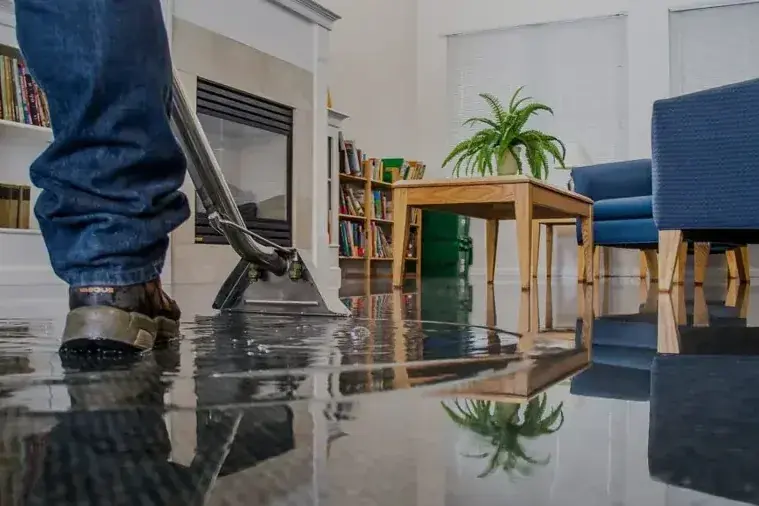
First steps for water extraction and removal
- Stop the source. Close the main valve or the fixture shutoff so no new water arrives.
- Keep clear of outlets. Switch off circuits in wet rooms at a dry panel before walking through.
- Take photos. Capture the standing water before any of it is removed.
- Lift contents. Move furniture onto blocks or out of the room so the floor can be extracted.
Every gallon pulled out as liquid is a gallon the dehumidifiers never have to evaporate. That is why extraction comes first on almost every loss, from a burst pipe in a Lake Grove kitchen to a flooded daylight basement in Mountain Park.
How the extraction crew pulls the water out
The crew starts with a moisture map so the extraction covers everything wet, not just the visible puddle. Then the equipment matches the surface:
- Hard floors and concrete: squeegee wands and truck-mounted vacuum lift standing water in overlapping passes.
- Carpet and pad: weighted extraction tools press water out of the pad, so carpet can often be dried in place on a clean-water loss.
- Lower levels and crawl spaces: submersible pumps move deep water, then portable extractors finish the job.
- Behind baseboards: trapped water is opened up and drained so it cannot keep wicking up the wall.
What does water extraction and removal cost in Lake Oswego, OR?
In Lake Oswego, OR, emergency water extraction with the initial drying set-up typically runs $1,000 to $4,500, depending on the square footage, the water category, carpet versus hard floors and whether a lower level or crawl space needs pumping.
One room
$1,000 to $2,000Clean water on one floor, extracted and set up for drying.
Several rooms
$2,000 to $3,500Carpet and pad extraction across a floor, with equipment set.
Lower level or crawl space
$3,000 to $4,500Pumping deep water out of a lower level or crawl space before drying.
Ranges are typical, not a quote: the water category, square footage, material class and how fast drying started move the number most. Run the water damage cost calculator for a closer range.
Why fast extraction keeps the bill down
Clean supply water left for a day or two picks up contaminants from flooring and soil and can turn into Category 2 or 3. At that point pad and drywall come out instead of drying in place. Early extraction also shortens the structural drying that follows, and on a carpeted room caught quickly the restoration team often saves both the carpet and the pad.
What happens once the water is out
Air movers and LGR dehumidifiers go in during the same visit, placed to each room's evaporation load. The drying team returns daily to log readings until every material reaches its dry reference. Ready.gov flood safety covers the electrical and health precautions around standing water, and the Oregon Division of Financial Regulation explains how homeowners claims work in the state.
How water extraction and removal work is held to a standard
Rapid local response
Dispatch runs 24/7, and active water anywhere from Lake Grove to Old Town is treated as urgent, holidays included.
IICRC S500 drying standard
Air movers and LGR dehumidifiers are sized to each room's evaporation load and stay in place until the readings say dry.
Claim-ready documentation
Moisture maps, daily psychrometric logs and timestamped photos are taken before anything wet is removed.
Local water know-how
Crawl spaces under fir-shaded roofs, daylight basements on hillside lots and pipes exposed in an ice storm shape every plan.
Water extraction and removal from Old Town to the west hills
24/7 dispatch reaches every street in the coverage map, day or night.
The local restoration pros cover ZIP 97034 and 97035, from First Addition and Old Town near the lake to Lake Grove, Westlake, Mountain Park, Palisades, Forest Highlands and the homes off Stafford Road.
Nearby coverage reaches West Linn, Milwaukie, Gladstone, Tigard, Tualatin, Rivergrove, Dunthorpe, Southwest Portland.
Related water damage services
Structural Drying and Dehumidification
Framing, subfloor and hardwood dried with LGR and desiccant units to a dry reference.
See the details ›Basement Flooding Cleanup
Daylight basements and lower levels extracted, opened where needed and dried to a reading.
See the details ›Crawl Space Water Removal
Water pooled on the vapor barrier pumped out, sagging insulation pulled and joists dried.
See the details ›Water Extraction and Removal questions
Can wet carpet be saved after extraction?
Often, on a clean-water loss caught early. Weighted extraction pulls water out of the pad and the carpet dries in place. Gray or black water means the pad comes out.
Why not just run fans?
Fans move air, but they do not remove standing water or the water held in pad. Extraction first, then air movers and dehumidifiers, cuts the drying time.
Is water in a crawl space extracted too?
Yes. Submersible pumps move pooled water off the vapor barrier, then the crew removes wet insulation and sets drying equipment under the house.
Why use a truck-mounted unit?
It moves far more water than a shop vacuum and keeps running without emptying a tank, which matters on large floors and lower levels.
Does extraction count as mitigation for insurance?
Yes. Extraction and drying are mitigation, the work insurers expect to start promptly. Coverage depends on your policy, so check with your own insurer.
How soon should extraction start?
As soon as possible. Water keeps moving into drywall and framing, and mold can start growing on wet materials in 24 to 48 hours.
Water sitting on the floor?
Water left in place soaks into pad, drywall and framing. The extraction crew pulls it out and sets the drying.
(888) 373-8814Have the extractors brought in