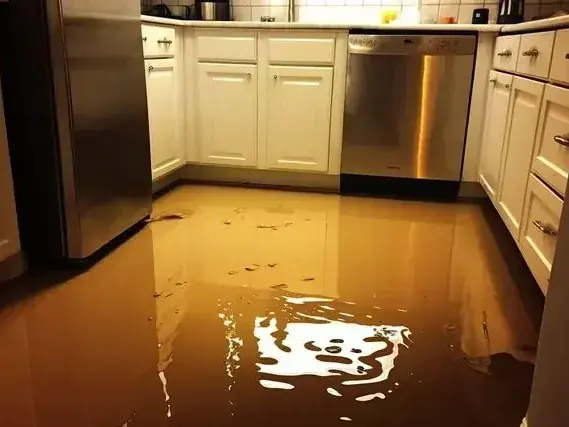
When a roadway water main burst near Timothy Place in May 2026, several streets flooded. A pipe that fails inside a house is a very different problem, and the first job is working out which one is happening.
Key takeaways
- A public main break shows up in the street, often with a shutoff for the whole area, while a burst pipe shows up indoors as wet walls, ceilings or floors.
- The city has seen both kinds of water: a main break on November 23, 2019 closed a street and shut off water, and the May 2026 break flooded several streets.
- A water meter that keeps moving with every fixture off points to a leak on the house side.
- A burst pipe indoors is stopped at the main shutoff, then the water is extracted and the wet materials are dried.
- The local building office issues plumbing trade permits, so it is the place to ask about repair work.
Two problems that can look alike
Both start with unexpected water and a drop in pressure. Both can leave a homeowner standing in a wet yard or hallway wondering who to call.
A public main is part of the street system, and a burst pipe indoors is a problem inside the building. The cleanup, and the people involved, are different.
Speed matters on the house side, because every minute a pipe runs, more water moves into drywall, flooring and insulation.
What the area has seen
On May 14, 2026, a roadway water main burst near Timothy Place and flooded several streets. Tigard Police and Public Works responded.
On November 23, 2019, a water main break closed a street and shut off water in the area. Both were failures of the public main, not of a house pipe.
Each event shows how fast a failure on the street can change a household's day, with closed roads, shut-off water and wet yards.
When service comes back after a main break, a few checks are worth the time.
- Open taps slowly and let the air sputter out.
- Look under every sink for drips.
- Check the water heater and its connections.
- Look at ceilings below bathrooms and the laundry.
- Read the meter again with everything off.
Clues that point to the street or to the house
No single clue is proof. Two or three together usually are.
Clues that point to the street
- Water running along the pavement or pooling at a curb with no storm
- Neighbors reporting low pressure or no water at the same time
- Barricades or crews appearing on the road
- A notice about an area shutoff
Clues that point to the house
- A damp spot on a wall, ceiling or floor that keeps growing
- A hissing or dripping sound inside a wall, or a warm patch on a floor
- Stains under a bath or above a garage ceiling
- A meter dial that keeps turning with every fixture off
A quick meter check
The water meter settles most arguments. It takes a few minutes and needs no tools.
Some meters carry a small triangle or a low-flow indicator that spins when water moves. A dial that creeps with everything off is the same signal at a slower speed.
- Turn off every tap, the ice maker and any appliance that uses water.
- Find the meter and watch the leak indicator or the dial.
- If it moves, water is going somewhere on the house side.
- Close the main shutoff. If the water indoors stops spreading, the source was a supply pipe.
- Write down the reading, wait, and read it again to see how fast it moves.
Why house age matters for pipes
The median home here was built in 1984, and 44 percent of homes date from 1970 to 1989. Another 33 percent were built from 1990 to 2009, and 5 percent in 2010 or later.
A house that has been in service for decades has had decades of pressure changes. Fittings, valves and hoses all deserve a look, whatever the pipe is made of.
Age is not a verdict. Plenty of older houses have sound plumbing, and plenty of newer ones have a hose that gave way.
Every house has a few weak spots, and finding them before a failure is cheaper than finding them after.
Good places to start looking are below.
- Shutoff valves under sinks and behind toilets that no one has turned in years
- Braided hoses at washers and dishwashers
- Connections at the water heater
- Exposed pipe in garages and outside walls
Cleanup after a burst pipe indoors
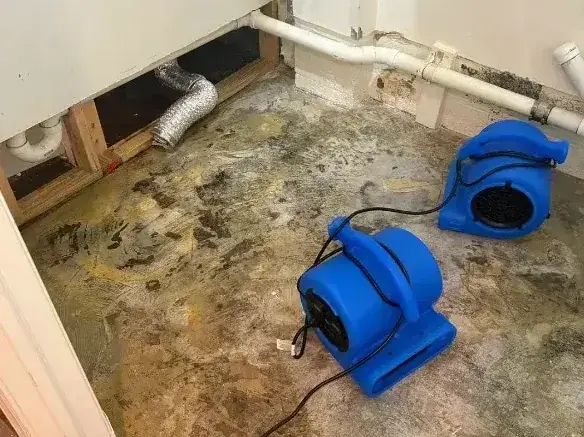
Once the main shutoff is closed, the next step is getting the water out. Water extraction pulls standing water off the floor and out of carpet before it moves into walls and subfloor.
Water from a burst supply pipe starts out clean, which gives a short window. If it sits in carpet, pad and wall cavities it can pick up contamination, so speed matters even when the source is clean.
Ceilings below a failed pipe deserve a look even when they seem dry, because water follows framing and shows up far from the break.
Burst pipe water damage cleanup then follows the water into the places it hides, and the Tigard water damage pros open only what the readings call for. A typical sequence looks like this.
- Floors and carpet are extracted.
- Wet drywall and insulation are opened where readings show moisture inside the wall.
- Dehumidifiers and air movers dry the cavities.
- Readings repeat until a dry reference is met.
- Wet insulation in the ceilings below is pulled.
The repair itself
Fixing the pipe is plumbing work, and Tigard Building Services issues trade permits for plumbing, electrical, mechanical, fire protection and solar work. Anyone planning a pipe repair should ask the office what the work needs before walls are closed.
For the water side of a pipe failure, the same crew also handles burst pipe repair and drying once the pipe is stopped.
A useful list for the plumber: where the break was, what failed, whether pressure at the house is normal, and whether other connections show wear. If the plumber removes a section of pipe, keeping it shows how the failure happened.
Questions
How can a homeowner tell a main break from a burst pipe?
A main break shows in the street and often cuts water to the area. A burst pipe shows as wet walls, ceilings or floors, and the meter keeps moving with every fixture off.
Who handles water running in the street?
Tigard Public Works responded to the May 2026 break near Timothy Place, so street and main problems belong with the city.
Can a main break cause damage inside a house?
It mostly affects streets and service. Pressure changes when water returns can expose a weak pipe or fixture inside, so a walk-through after service resumes is worth the time.
What gets shut off first when a pipe bursts inside?
The main water valve. After that, the power is checked if water is near outlets, and extraction can begin.
Does a pipe repair need a permit?
Tigard Building Services issues plumbing trade permits, so it is the right office to ask. What a given repair needs is for that office to say.
Is the water from a burst pipe clean?
At first it is clean supply water. If it sits in carpet, pad and wall cavities it can pick up contamination, so extraction and removal should not wait.