
On December 7, 2015, Kellogg Creek overtopped its banks, and the Clackamas County Fire Department water rescue team evacuated a Milwaukie neighborhood between Lake Road and Highway 224. Creek water that gets into a house is not rain water, and the cleanup follows different rules.
Key takeaways
- Kellogg Creek overtopped its banks on December 7, 2015, and crews rescued about 50 people by cataraft and by wading through hip-deep water.
- Creek water carries silt, debris and whatever lies along the banks and streets, so it is treated as contaminated water.
- Wet carpet, pad, insulation and low drywall usually come out, while hard surfaces are cleaned and treated.
- Garages and lower levels take the water first, so stored items and utilities there need attention early.
- Drying starts after the water and the removed materials are gone, and readings decide when it ends.
What the December 2015 flood showed
The rain that week was a record. Record rain fell across the Pacific Northwest from December 7 to 11, 2015, and Portland received 2.67 inches on December 7, a December calendar-day record.
In Milwaukie, Kellogg Creek overtopped its banks, and Lake Road and Rusk Road were closed for most of the day. Crews waded hip-deep water and used a cataraft to rescue about 50 people.
Water also reached garages and homes near the creek. That is the part restoration crews deal with once the creek drops.
More than one flood source
Kellogg Creek flows northwest along the southern edge of the city to the Willamette River. It is one of several waterways that have put water where people live, and FEMA's county flood study notes that scattered business and residential structures along the Willamette River, Johnson Creek and Kellogg Creek lie in flood plains.
The other waterways on that list include these.
- Mount Scott Creek, a tributary of Kellogg Creek, has flooded near Rusk Road and Lake Road.
- Johnson Creek meets the Willamette River in the city, and the December 2015 storm produced its highest recorded peak flow.
- The Willamette River itself flooded business and residential areas in December 1964.
Why creek water counts as contaminated water
Rain that leaks through a roof is usually clean when it lands. Creek water is not, because it crosses yards, driveways and streets before it reaches a house and collects soil, debris and whatever else it passes.
Restoration standards place floodwater from creeks and rivers in the most contaminated group, called Category 3. That label changes what is allowed to stay in the house.
Time matters too, because contaminated water that sits in porous materials spreads into them, which is why removal does not wait for the drying plan. These items usually come out.
- Carpet and carpet pad that sat in the water
- Insulation in walls and floors that touched it
- Drywall and trim along the lower part of the walls
- Soaked cardboard, upholstered items and other porous contents
While the creek is still high
Cleanup cannot begin until the water drops, and the time in between is for staying safe.
- Stay out of moving or standing creek water.
- Turn off power at the panel only from dry ground, and never touch a switch while standing in water.
- Keep children and pets away from flooded areas.
- Photograph from a dry spot: the water level, the damage and any floating debris.
- Skip household vacuums and fans, which are not made for wet floors.
The first day in a creek-flooded house
Speed matters, but the order matters more.
Safety first
Standing water can be deep, and power may still be on. Nobody should wade in until electricity to the affected area is off and the water level is understood.
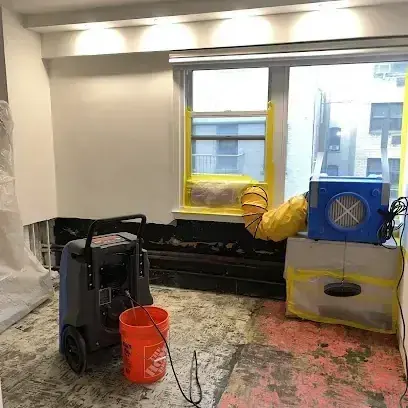
Crews work in boots, gloves and respirators when the water is contaminated.
Water out
Pumps and truck-mounted units remove the bulk of the water. In a garage that often means silt as well as water, which is shoveled up and hauled away.
Local water extraction work is built around this step.
Sorting what stays
Photos come first, then wet porous materials are cut out and bagged. The goal is to leave only what can be cleaned and dried.
Clean and treat
After removal, hard surfaces are washed to take off silt and then treated. Concrete, framing and other solid materials can usually be saved this way.
Garages and lower levels
Foundation types differ from house to house, so the plan starts with where the water actually went. Garages, utility rooms and lower levels usually get it first because they sit lowest.
Furnaces, washers and electrical panels often live there, along with boxes and tools. Lower level flood cleanup covers those spaces, not just the floors.
Silt is the quiet problem. It dries into a fine film that coats floors, walls and stored belongings, and it keeps holding moisture and odor if it is not washed off.
- Move belongings only after the water is out and the floor is safe.
- Keep electrical equipment off until it has been checked.
- Photograph the high-water mark on the walls before anything is wiped away.
- Check the furnace and water heater area for silt before restarting anything.
Drying, and what the creek's future means
Wet winters slow natural drying, so framing and subfloor are dried with equipment and measured until they match a dry reference. Storm water damage jobs often run through several rounds of readings before walls are closed.
Fans and heaters alone rarely finish the job. A house closed up in a wet winter without dehumidifiers stays damp inside.
Readings are taken on the slab, the bottom plates, the wall cavities and any wood that sat low in the house. Drying goes on until each material reaches the same dry reference.
The Kellogg Creek Dam, built in 1848 to power a flour mill, sits under the Highway 99E crossing. A restoration project plans to remove the concrete dam and reduce flooding risk.
A plan on paper does not change what the next storm can do, so preparation still matters. The Milwaukie water damage pros handle the cleanup side after the water is in.
Questions
Is creek water inside a house treated differently from a roof leak?
Yes. Creek water is handled as contaminated, so porous materials that touched it are removed and hard surfaces are cleaned and treated before drying.
Can carpet be saved after a creek flood?
Carpet and pad that sat in creek water are normally removed. They hold dirt that cannot be rinsed out.
Which Milwaukie waterways have flooded?
Kellogg Creek, Johnson Creek, Mount Scott Creek and the Willamette River have all flooded, and the December 2015 Kellogg Creek event is the best known recent case.
What should a homeowner photograph before cleanup?
The water level on the walls, the damaged floors and contents, and the garage or lower level as it stands. Photos should come before anything is moved or thrown out.
Does the Kellogg Creek project mean the flood risk is gone?
No. The project is a plan to remove the dam and reduce flooding risk over time, and homes still need to be ready for the next storm.
How long does cleanup take after a creek flood?
That depends on how much water came in and how much had to come out. Removal can move quickly, while drying is judged by readings, so the end date is set by the walls and floors rather than the calendar.