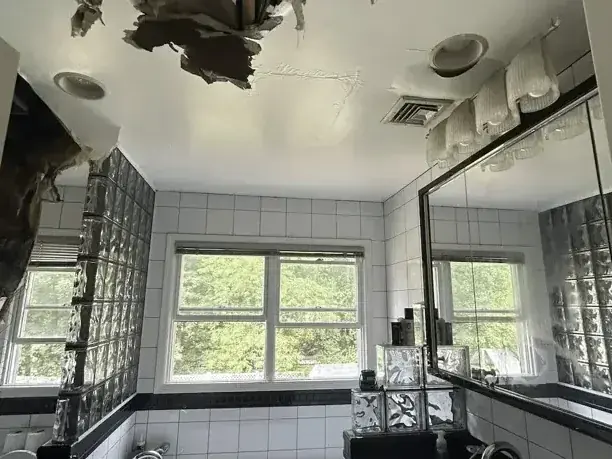
About 29 percent of Milwaukie's housing units are attached, and about 45 percent of rental units sit in buildings of five or more units. In those buildings, a leak in one unit can reach the ceiling below long before anyone upstairs notices.
Key takeaways
- A leak above shows up below as a stain, a sag, bubbling paint or a drip at a light fixture.
- A sagging ceiling can hold a lot of water, so nobody should stand under a bulge.
- Photographs, the date and a quick note to the neighbor, owner or manager set the repair in motion.
- Drying has to cover the ceiling, the joist bays and often the shared walls, sometimes in both units.
- Attached housing is growing, because the 2022 zoning update allows duplexes, triplexes, townhomes and cottage clusters.
How a leak travels in attached housing
About 70 percent of the city's housing units are detached homes, and about 29 percent are attached. Oregon's House Bill 2001 requires cities to allow duplexes, triplexes, townhomes and cottage clusters where single detached homes are allowed, and the city updated its zoning code to comply in 2022.
More shared walls and floors mean more ways for water to move between homes.
In the 2010 Census, 41.5 percent of occupied units were rented, and about 45 percent of rental units are in buildings of five or more units.
That mix matters because the household below is often not the one that can shut the water off. A renter downstairs may need an owner or manager to act, and the household upstairs may not know the water is running.
Water does not stop at the floor of the unit above. It follows the easiest path: down a pipe chase, along a joist, through a gap around a drain or into a wall cavity.
What a leak above looks like below
The stain is the visible part of a leak above. Three things are worth knowing about what shows up below.
Signs on the ceiling and walls
- A brown or yellow stain that keeps spreading
- Paint that blisters or peels
- A ceiling that sags or bulges
- Drips from a light fixture or a vent
- A damp smell in a closet or along an upper wall
The danger sign
A bulge is the dangerous sign. It means water is pooling in the drywall, and the panel can drop without warning.
What the water carries
The water matters as much as the stain. A supply pipe leak starts as clean water, but a toilet overflow, a drain failure or a washer discharge hose carries contaminated water, and that changes what has to come out.
Telling a plumbing leak from a roof or wall leak
Not every ceiling stain comes from the unit above. A top-floor unit can also have a roof leak, and any unit can have water coming through an exterior wall.
The right source decides who needs to act, so noting when the stain grew in relation to the rain is useful before anyone is blamed.
- Stains that appear only after rain point to the roof or an exterior wall.
- Stains that keep growing in dry weather point to plumbing.
- A stain near a bathroom or kitchen wall points to a fixture, drain or supply pipe above.
- A stain directly under a toilet or tub points to that fixture.
First steps for the unit below
Stay safe
Stay out from under a sagging section. Switch off any fixture that is dripping, and leave the breaker off if water is near wiring.
Document and tell
Photograph the ceiling, the wet floor and any damaged belongings, and note the date. Tell the neighbor above and the owner or property manager, and ask for the water to the unit above to be shut off.
Ask for the repair date and for confirmation that the supply to the leaking fixture has been closed.
Protect what can be moved
Move what can be moved out of the wet zone, and set a container under any drip.
- Lift rugs and boxes off wet floors.
- Unplug electronics near the stain.
- Cover furniture with plastic.
- Leave cabinets and drawers under the stain open to the air.
Common sources in the unit above
The cause is often something ordinary that gave way while nobody was watching. A slow drip often goes unnoticed for weeks and shows up as a stain only after the floor above has been wet for a long time.
- A washer hose or dishwasher supply that failed
- A toilet supply or a tub that overflowed
- A bath fixture or a shower pan
- A supply pipe in a wall or floor
- A water heater in a closet
How drying works across two units
Ceiling leak water damage is rarely only a ceiling problem. Water runs along joists, down the inside of walls and into the floor cavities above and below.
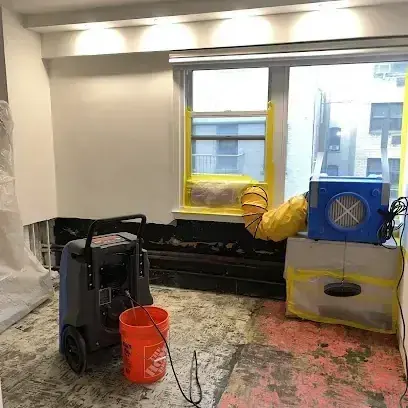
The crew opens the ceiling where readings show moisture, removes wet insulation and dries the joist bays. In attached buildings the readings often continue into shared walls, which is why a ceiling leak drying plan covers more than one room.
Painted and textured ceilings can hide moisture, so readings are taken above and around the stain as well as at it. When the ceiling is opened it is cut in straight lines, which keeps the later repair simple.
- Moisture mapping in both units where access allows
- Wet drywall and insulation removed
- Dehumidifiers and air movers placed to dry the cavity
- Readings repeated until a dry reference is met
- Shared walls checked for moisture on both sides
Working with a neighbor, an owner or a manager
Several people are usually involved: the household upstairs, the owner and sometimes a manager or a homeowners association. A clear paper trail helps every one of them.
Questions about responsibility can follow later. Stopping the leak and drying the ceiling come first, and when a failed hose or appliance is the cause, appliance leak water damage steps apply upstairs while the Milwaukie water damage pros work on the unit below.
A short written note works better than a hallway conversation. It records the date, names the wet spots and asks for the water to be shut off.
These habits keep the record clean.
- Keep dated photos of every wet surface.
- Save messages sent to the neighbor, owner or manager.
- Write down when the leak was noticed and when the water was shut off.
Questions
Why do leaks in attached homes spread so far?
Shared walls and floor cavities give water more paths. A leak above can travel along joists and down the inside of walls before a stain shows.
Should a bulging ceiling be popped?
Leave a bulge alone and stay out from under it. If it needs to be drained, that is a job for the crew with the right protection.
Who should be told first about a leak from above?
The household above and the owner or property manager, so the water can be shut off. Photos and the date should be saved at the same time.
Do both units need drying?
Often, when water moved through a shared wall or floor cavity. Readings in each unit show where the moisture went.
Does the leak have to be shut off before cleanup starts?
Yes. Drying cannot finish while new water is still arriving, so the source is stopped first.
What if the unit above is empty?
Water can run for days in an unoccupied unit. The owner or manager can enter to close the shutoff, and the leak is stopped before drying begins below.