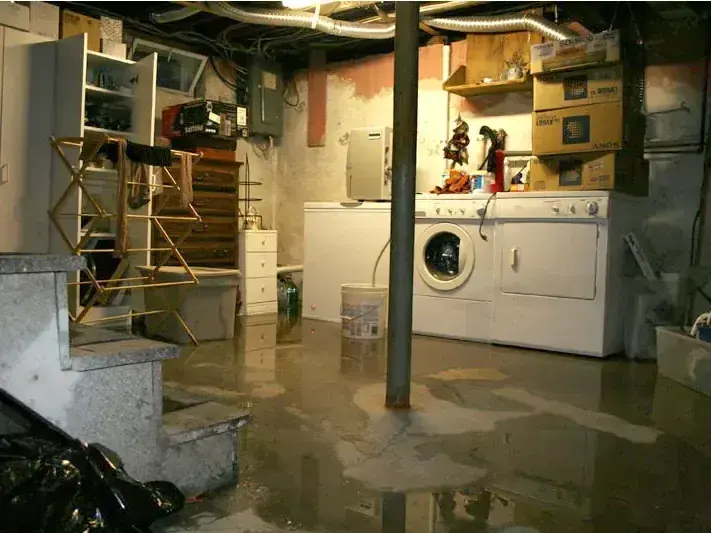
Many Lake Oswego homes sit on hillside lots with daylight basements, where one side of the lower floor opens to the slope below and the other sides press against the hill. In a long October to April storm, that layout gives water two ways in.
Key takeaways
- A daylight basement has soil on the uphill side and doors or windows on the open side, so water can arrive at either end.
- The first signs are a damp carpet edge, a wet slider threshold, water at a floor drain or a stain along the base of the uphill wall.
- Power, belongings and the water source come first, and extraction follows.
- Finished walls, carpet pad and insulation hold water and usually have to be opened or removed.
- Lower levels dry slowly in the wet months, so dehumidifiers and readings decide when the job is done.
Why hillside lots collect water at the lower level
A daylight basement is a lower floor that opens to the yard on the downhill side. The uphill walls and slab sit against the slope.
Rain that runs downhill meets the uphill wall first. Wind-driven rain meets the doors and windows on the open side, and long atmospheric-river storms test both.
Hillside lots also drain unevenly. A driveway, patio or lawn that slopes toward the house can send runoff straight to the lower-level entry, and a blocked window well can fill like a bucket against the glass.
Where the water shows up first
The first signs depend on where the water gets in. A musty smell is a late sign, because by then the pad and the bottom of the drywall are often wet.
Inside the lower level
- At the base of the uphill wall, where carpet edges feel damp
- Along the threshold of a sliding door or a lower-level exterior door
- Around a floor drain, if the drain is the lowest point
- Under baseboards, where paint bubbles or trim swells
- In a finished storage closet tucked against the hill
- Along the joint where the slab meets the wall
- At window wells that no longer drain
Outside the house
- A soggy slope above the house
- A downspout that empties beside the foundation
- A window well holding water
- A driveway or patio that slopes toward the lower-level entry
The first steps
Daylight basements often hold bedrooms, offices or media rooms, so the damage is not limited to storage, and a few quick decisions shape everything that follows.
Safety and power
If water is near outlets, power to the lower level goes off at the panel, but only when the panel can be reached without stepping into water.
Wet drywall, wet carpet and wet outlets are a poor mix. If anything buzzes, smells hot or trips a breaker, the room stays off limits until it has been checked.
Stop the source if there is one
A burst pipe or a failed water heater is stopped at its shutoff. Rain and runoff cannot be shut off, but clearing a blocked window well or downspout outlet can slow the flow.
Protect belongings
Lift furniture onto blocks, move boxes up and pull rugs out of the wet zone.
What to photograph
Wide shots of each room, close shots of the wettest spots and walls, and a shot of any outside source such as a clogged window well. Dated photos make the sequence easy to follow.
What extraction and removal cover
Water extraction uses pumps and wet vacuums to take standing water out and pull water from carpet. Pad is usually removed instead of dried.
Hard surfaces such as the concrete slab are cleaned and left to dry, and water that came through a wall carries soil, so surfaces are washed before equipment goes in. Materials that soaked up the water usually come out, as listed below.
- Carpet pad, and often the carpet itself
- Insulation against the uphill wall
- The bottom of finished drywall, cut above the wet mark
- Stored cardboard and paper
- Laminate or engineered flooring that has swollen

Why a finished lower level hides the problem
Drywall wicks. Water that touches the bottom of a wall climbs inside the board and into the stud bay, so a wall can look dry on the face while the cavity is wet.
Carpet pad works the same way. It holds water like a sponge, and the wet pad keeps feeding moisture into the slab edge and the bottom plate.
Mold becomes a concern when that moisture stays trapped, which is why wet walls are opened rather than left to dry on their own.
- Readings at several heights show how far water has climbed.
- The bottom plate and the base of the studs are checked for moisture.
- Insulation in the wall is pulled when it is wet.
- Cabinets and built-ins are checked behind toe kicks.
Drying a lower level in the wet months
Lower levels are cool, and the air is humid from October through April. Without equipment, a wet slab and wall cavity can stay damp for a long time.
Basement flooding cleanup ends with dehumidifiers, air movers and repeated readings. The job closes when the numbers match a dry reference.
Cut-out drywall also opens the stud bays so air can reach the framing and the back of the wall.
A dehumidifier in a cool lower level has to work harder, so crews watch the room temperature as well as the humidity.
Closing the room off from the rest of the house keeps the drying zone small, and a closed door or a plastic sheet helps the dehumidifiers do their job.
Keeping the next storm out
A basement that flooded once is a good candidate for a short checklist before the next atmospheric river, because storm water damage often starts with something small that was never cleared.
No list makes a hillside house waterproof, but each of these steps removes one easy path for the water.
- Clear gutters. Moss clogs gutters and sends roof water toward the foundation.
- Make sure downspouts discharge away from the house on the uphill side.
- Keep window wells and slope drains clear of debris.
- Look at door and slider seals before the wet season starts.
- Walk the slope above the house after a storm and note where the water flows.
Questions
Why do daylight basements on hillside lots collect water?
The uphill walls and slab sit against the slope, and the open side has doors and windows. Runoff and wind-driven rain each find a path.
Is the water always runoff?
No. A pipe, a water heater or an appliance can also be the source, so the source is checked before anything else.
Do finished walls always have to come out?
Not always. Walls are opened where readings show moisture behind the drywall, and the cut usually sits above the wet mark.
Can a wet carpet be saved?
Sometimes when the water was clean and the carpet is lifted quickly. Pad is usually replaced, and carpet that sat in dirty water is removed.
How long does a daylight basement take to dry?
Readings decide. Cool, humid wet-season air slows drying, so equipment stays until the numbers match a dry reference.
What about built-in cabinets or a bar in the lower level?
Particleboard swells and rarely dries back to shape, while solid wood often can be dried in place. Toe kicks and the space behind cabinets are checked because water collects there.